
The Street Vote
Who can force Ukraine's government to reverse its decisions while elections remain suspended — and how?
Who influences the decisions of the Ukrainian authorities while elections remain suspended, and by what means?
What we found
Assessment
Elections remain the only means of conferring a political mandate. Their suspension, however, does not leave Ukraine's government free to act as it chooses. The president and parliament retain their formal powers, but the range of politically viable decisions is shaped by a wider system. It includes public pressure, anti-corruption institutions that are in practice insulated from ordinary Ukrainian control, and foreign partners on whom Ukraine depends for funding, weapons and international support.
This system does not replace elections, but it can already exercise a political veto. It can force the authorities to repeal a law, reverse a personnel decision or remove an official. Its leverage is strongest when demands from the street align with institutional action and the interests of foreign partners.
Mykhailo Fedorov's case reveals both the strength and the limits of this mechanism. The protests helped secure Commander-in-Chief Oleksandr Syrskyi's dismissal, but they did not return Fedorov to the Ministry of Defence. Yevhen Khmara's appointment made such a return all but impossible. Fedorov's attempt to convert accumulated support into a political platform also met resistance: protest organisers rejected his call for wartime elections and ended their daily demonstrations.
Fedorov's record in office has therefore become political capital, but not yet an organised political force. Those who backed him as a minister and advocate of defence reform did not accept his claim to set their political agenda. This was the first serious test of his independence after leaving office, and he failed it.
Although elections are not being held in Ukraine, political decisions still have to pass a test of domestic and external acceptability. The president, the government and the Verkhovna Rada retain their lawful powers, but they do not enjoy complete freedom of action. Over the past thirteen months, public protests, anti-corruption investigations and demands from foreign partners have repeatedly forced the authorities to revisit decisions already taken. Ukraine's government has retained its formal powers, but it has lost its monopoly over personnel and legislative initiatives.
Five principal findings follow. They are not presented as judicial proof of covert arrangements. They are analytical judgements about the most likely mechanisms, based on the sequence of events, the conduct of the actors involved and the price the Ukrainian authorities would have paid for refusing to concede.
The strongest pressure on Ukraine's authorities arises when public demands, institutional action and the interests of foreign partners converge. That combination forced the repeal of the law curtailing the independence of NABU and SAPO. Protest created a domestic political cost, the anti-corruption bodies defended their autonomy, and the European Union linked the issue to Ukraine's obligations to its partners. Keeping the law became more costly than repealing it. This was not coincidence but structure: the authorities may ignore one source of pressure, but three acting together constitute a political crisis.
The July protests were the decisive factor in Syrskyi's dismissal. Demonstrators issued an ultimatum with a deadline of 24 July; Zelenskyy acted on 21 July and publicly said that he had heard society. The long-running conflict with the Ministry of Defence explains why dismissal was possible, but the protest turned an internal dispute into an immediate political problem that could no longer be deferred.
Zelenskyy's principal potential rivals are people to whom he himself gave a national platform. Public office turned Valerii Zaluzhnyi, Kyrylo Budanov and Mykhailo Fedorov into national figures. Their popularity was not automatic: it came from their records, the experience of war and the public's response to their conflicts with the governing system. The presidential vertical elevated them but could not retain control of the political capital they accumulated. Poroshenko is the only one of the four whom Zelenskyy does not lose to in the polls. The main threat therefore comes not from the old opposition, but from figures created inside Zelenskyy's own system.
Fedorov retained high trust after leaving office, but his political support proved narrower than his popularity as an administrator. In a July poll, only 16% of respondents distrusted him, the lowest figure among the politicians examined. Yet on 20 August, protest organiser Dmytro Koziatynskyi rejected Fedorov's call for wartime elections, said the demonstrations had been about defence reform rather than the former minister's political future, and backed the new minister, Yevhen Khmara. The public supported Fedorov as an effective official but had not given him a political mandate. Popularity without a party machine or mandate is an asset that fades unless converted quickly.
Fedorov left office with his name, reputation and an internationally recognised defence-tech agenda, but he still lacks an independent political force. Reports of a mass departure from the ministry were not substantiated. Protest organisers distanced themselves from his election proposal. His representatives said a possible US trip concerned funding for defence-tech projects and stressed that no meetings with American politicians were planned. That weakens the theory that foreign actors were immediately launching him as a candidate. Access to international technology and investment networks nonetheless gives him an asset few Ukrainian politicians possess. Unless he converts it into a party, campaign organisation and programme by the end of the year, those links will remain an impressive biography rather than a political force.
Gap
This report relies on open sources. Where the evidence ends, so does the analysis. We do not claim that a single centre stands behind the protests, investigations and personnel decisions: open sources do not support such coordination, and it is not required to explain the events.
Nor does the report predict the winner of a future election. It identifies which figures already command public support, what resources they control and whether they can turn personal popularity into an organisation, funding and a durable coalition. As of 21 August 2026, Fedorov had not done so.
Full study
Evidence, sources, alternative explanations and scenarios
Introduction · A testable question
The principal actors in brief
- Volodymyr Zelenskyy — president of Ukraine since 2019. He was elected for a five-year term, which formally expired on 20 May 2024. No subsequent presidential election has been held because martial law remains in force. Under the Constitution of Ukraine, an incumbent president continues to exercise his powers until an elected successor takes office. - Mykhailo Fedorov — a former minister of digital transformation and minister of defence, and one of the architects of Ukraine's technological modernisation and defence-tech sector. His dismissal in July 2026 triggered weeks of street protests. - Oleksandr Syrskyi — commander-in-chief of the Armed Forces of Ukraine until 21 July 2026. His conflict with Fedorov over military management and reform was one of the causes of the personnel crisis. - Mykhailo Drapatyi — a combat-experienced general who replaced Syrskyi as commander-in-chief after protesters demanded a change in military leadership. - Yevhen Khmara — the former commander of the Security Service of Ukraine's Alpha special operations unit, appointed minister of defence on 19 August 2026. His appointment effectively closed Fedorov's path back to the ministry.
In this report, the street vote means public pressure that does not replace an election but can force the authorities to reconsider a particular decision.
On 19 August 2026, Ukraine's Verkhovna Rada approved Yevhen Khmara as minister of defence. The previous evening, the man he replaced had called for a lawful mechanism to hold elections. On the same day, the National Anti-Corruption Bureau announced an operation targeting people linked to Zelenskyy's inner circle, and a deputy head of the Office of the President was dismissed within hours.
The timing does not prove that a single centre directed these events. It does show, however, that although the authorities still appoint the government and carry decisions through parliament, they do not have complete freedom of action. Public pressure, anti-corruption bodies and Ukraine's dependence on foreign support all constrain their choices.
This leads to the report's central question:
Who influences the decisions of the Ukrainian authorities while elections remain suspended, and by what means?
These mechanisms cannot replace an election. Protests, investigations and opinion polls neither confer a right to govern nor determine who will become the next president. Yet while voting remains suspended, decisions are still shaped by the street, anti-corruption bodies, parliament and the foreign partners on whom Ukraine depends for funding, weapons and international support.
Fedorov's case shows how this system works. He went from presidential appointee to former minister while retaining strong public support. His experience reveals what a politician may carry away after leaving office — and what remains with the state once the office is gone.
Gap
Method. Sequence is not causation. The terms "led to", "caused" and "reversed" are therefore used only where sources support the connection. In other cases, we consider more than one plausible explanation. All facts were checked against open sources. Where a primary document could not be found and information is drawn from a secondary account, the notes say so explicitly.
Part One · Thirty-six days that changed the political landscape
The dismissal of the entire government
On 14 July 2026, the Verkhovna Rada dismissed Prime Minister Yuliia Svyrydenko's government in its entirety. Fedorov was not removed by a separate decision: his mandate ended with that of the whole cabinet. This frequently overlooked fact changes the interpretation of events. Without it, the reshuffle appears to have been directed at Fedorov personally.
The government's collective dismissal did not in itself mean that Zelenskyy had lost confidence in Fedorov. What followed matters more. Fedorov was not included in the new government headed by Serhii Koretskyi from 16 July. On 15 July, he publicly linked his departure to his conflict with Commander-in-Chief Oleksandr Syrskyi and said the ministry's initiatives had repeatedly been blocked. Fedorov later rejected other posts offered to him and, on 31 July, was removed from the National Security and Defence Council.
The decisive issue, therefore, is not the cabinet's dismissal in isolation but the chain of events that followed.
The protests and the commander's dismissal
From mid-July, demonstrations in support of Fedorov took place in Kyiv and several other cities. They were organised not by political parties but by veterans: former combat medic Dmytro Koziatynskyi and lawyer Masi Nayyem. They made three demands:
- Syrskyi's dismissal; - Fedorov's return to government; - an extraordinary session of the Verkhovna Rada.
The organisers gave the authorities until 24 July to comply.
On 21 July, before that deadline expired, Zelenskyy dismissed Syrskyi and appointed Mykhailo Drapatyi commander-in-chief. The other two demands were not met: Fedorov did not return to government and parliament did not convene an extraordinary session.
Assessment
What can be stated with confidence. The protests were the decisive factor in the dismissal. Four facts support that judgement: the demand to remove Syrskyi, the 24 July deadline, Zelenskyy's decision on 21 July before the deadline expired, and his statement that he had heard society. The prolonged conflict with the Ministry of Defence explains why removal was possible; the protest turned it into an immediate political problem.
Why Fedorov changed his position
On 31 July, Fedorov told The New York Times that he did not want to enter politics and had no intention of meeting the demonstrators campaigning on his behalf.
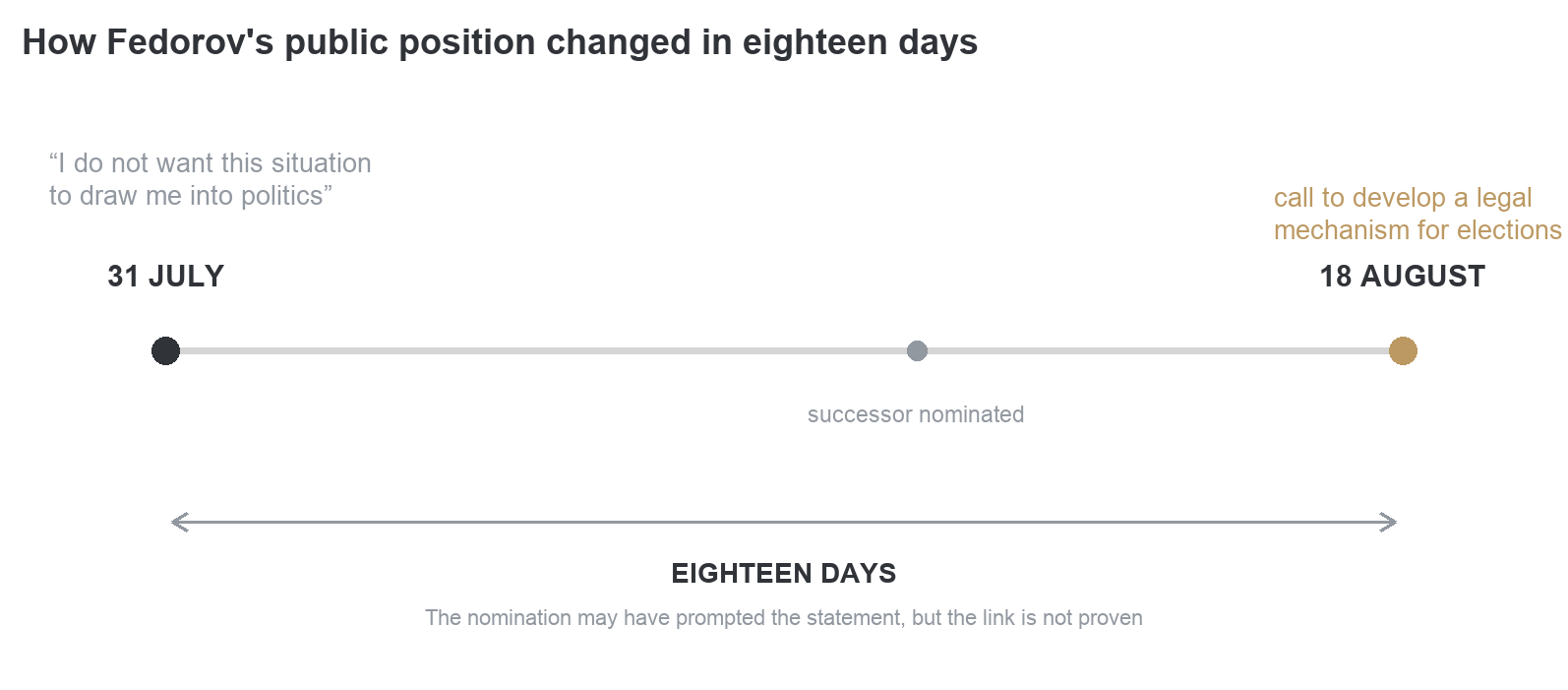
Eighteen days later, on the evening of 18 August, he released an address calling for a lawful, secure and realistic procedure for holding elections. Earlier that day, Zelenskyy had submitted a new defence minister's nomination to parliament. Once that happened, Fedorov's return to the ministry became highly unlikely.
Several motives are plausible. Fedorov may have wanted to preserve public support that would otherwise fade without a sustained public presence. He may have developed political plans earlier but chosen to reveal them only after Khmara's nomination. He may also have feared that the ministry's new leadership would claim credit for his reforms. The available evidence does not identify one of these explanations as dominant.
Three events on 19 August
On 19 August, more than three hundred Ukrainian MPs approved Khmara as minister of defence. The same day, the National Anti-Corruption Bureau of Ukraine (NABU) and the Specialised Anti-Corruption Prosecutor's Office (SAPO) announced a new operation codenamed Forest Gump. It was linked to Midas, a major investigation into an alleged corruption scheme in the energy sector involving serving and former officials and associated business figures.
One suspect in the Midas case was released on bail of UAH 150 million. Investigators allege that the bail money was channelled in four transfers through controlled companies. Zelenskyy dismissed Iryna Mudra, a deputy head of his office, on the same day.
If the investigators' account is substantiated, this was more than a financial offence. Companies may have been used to collect and move funds in order to free a participant in an earlier corruption scheme. That would indicate mutual protection within a network close to the centre of power. For understanding the network, this relationship matters more than the amount itself.
Unconfirmed
Procedural precision. A search is an investigative measure. It is not equivalent to formal suspicion, an indictment or a conviction. Dismissal does not establish an official's guilt. As of the cut-off date, the procedural documents relating to the 19 August operation had not been published in full, and the legal status of the individuals named could not be established from open sources.
Part Two · How decisions change without elections
Across the cases examined here, government decisions were shaped by street protests, anti-corruption investigations and demands from foreign partners. Sometimes these forces acted separately; sometimes they reinforced one another. Opinion polls do not change laws or remove officials, but they tell both the authorities and their opponents whom the public is prepared to support.
Street protests
In July 2025, Ukraine's parliament passed a law curtailing the independence of NABU and SAPO. Protests followed, while representatives of the European Union publicly criticised the law. Nine days later, parliament reversed the contested changes. Domestic pressure and the demands of foreign partners converged and forced the Ukrainian authorities to retreat.
In July 2026, demonstrations supporting Fedorov accompanied a new personnel crisis. Protesters demanded Syrskyi's dismissal and set a deadline. Zelenskyy acted before it expired. Public pressure was one of the decisive factors behind the dismissal.
Anti-corruption investigations
In November 2025, Andriy Yermak, head of the Office of the President, resigned shortly after a search. Following the anti-corruption agencies' operation of 19 August 2026, Zelenskyy dismissed his deputy chief of staff, Iryna Mudra. Both cases show that investigations can reach the president's inner circle and trigger rapid personnel decisions.
The attempt to curtail NABU and SAPO did not stop their work. Parliament quickly reversed the restrictions described above, but the confrontation continued. On 10 August 2026, NABU and SAPO alleged that judges hearing cases involving their employees were being pressured. The struggle over Ukraine's anti-corruption bodies therefore continues, although it has become less overt.
External dependence and parliament's role
Ukraine depends on Western funding, weapons, diplomatic backing and the prospect of European Union membership. Foreign partners consequently participate in the country's domestic politics in practical terms. They can make further assistance conditional on compliance with their requirements and thereby influence decisions in Kyiv.
This does not require direct orders. Influence operates through funding conditions, access to international institutions, political backing and the consequences the Ukrainian authorities would face if they refused. Nor is the West a single centre. American, British and European institutions may favour different outcomes and rely on different groups within Ukraine's governing system.
Formally, decisions belong to the Verkhovna Rada. It dismisses governments, confirms ministers and passes laws. But compliance with formal procedure does not amount to complete autonomy. Domestic and external pressure can make one option politically viable and another prohibitively costly for the president and MPs.
What the polls show
While elections remain suspended, polls reveal who is losing public support and who is gaining it. These findings affect the behaviour of the authorities, political groups and foreign partners. A rating does not itself repeal a law or remove an official. In the cases examined here, other forces changed the decisions; polls showed how much public backing those forces enjoyed.
Assessment
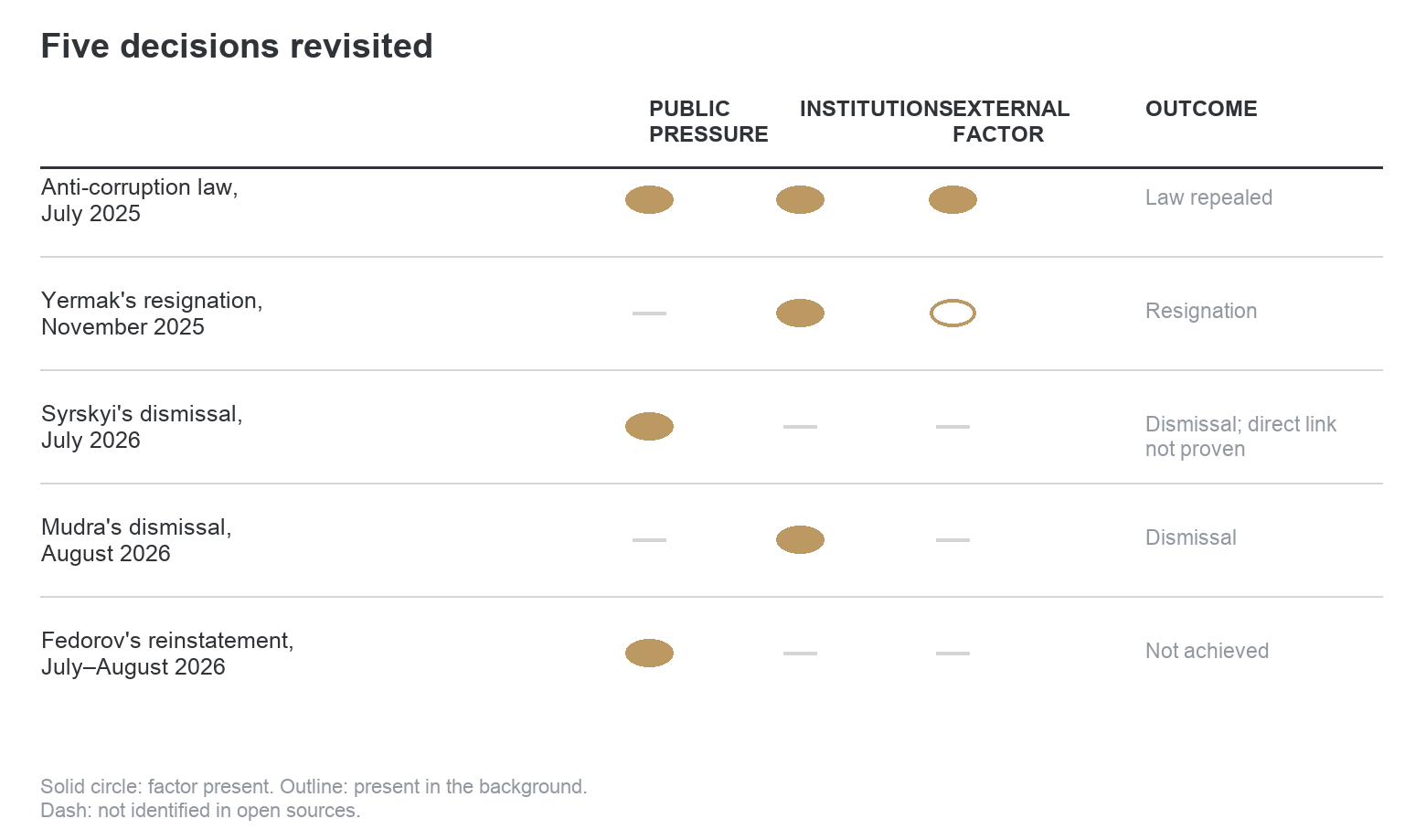
Preliminary assessment. In none of the five cases was a single factor sufficient to produce the full result. The authorities retreated more decisively when public pressure coincided with institutional action and demands from foreign partners. Each factor was weaker on its own.
In the cases examined, retreat occurred when all three forms of pressure converged. None produced the same result alone. If the authorities later concede in response to one source of pressure only, this assessment will need to be qualified.
The limits of these mechanisms
Protests, investigations and external pressure can force the authorities to repeal a law or dismiss an official. They cannot select a new leader or confer a lawful mandate to govern.
The July protests make this distinction clear. The authorities dismissed Syrskyi but did not return Fedorov to government. The demand for a removal succeeded; the demand for an appointment did not.
This creates a serious problem for the state. Discontent accumulates, but there is still no lawful mechanism for changing the country's leadership. Every successful protest and investigation raises expectations that pressure will work again. Yet no procedure currently allows society not merely to demand removals, but to choose a new government.
Part Three · Why Zelenskyy's appointees become his rivals
SOCIS, a Ukrainian public-opinion research centre, asked respondents to imagine a presidential run-off between Zelenskyy and each of four potential challengers. The incumbent lost three of those pairings.
All three winners achieved nationwide recognition through senior public office. Valerii Zaluzhnyi commanded the Armed Forces of Ukraine. Kyrylo Budanov headed military intelligence and became head of the Office of the President in January 2026. Mykhailo Fedorov rose from Zelenskyy adviser to minister of defence.
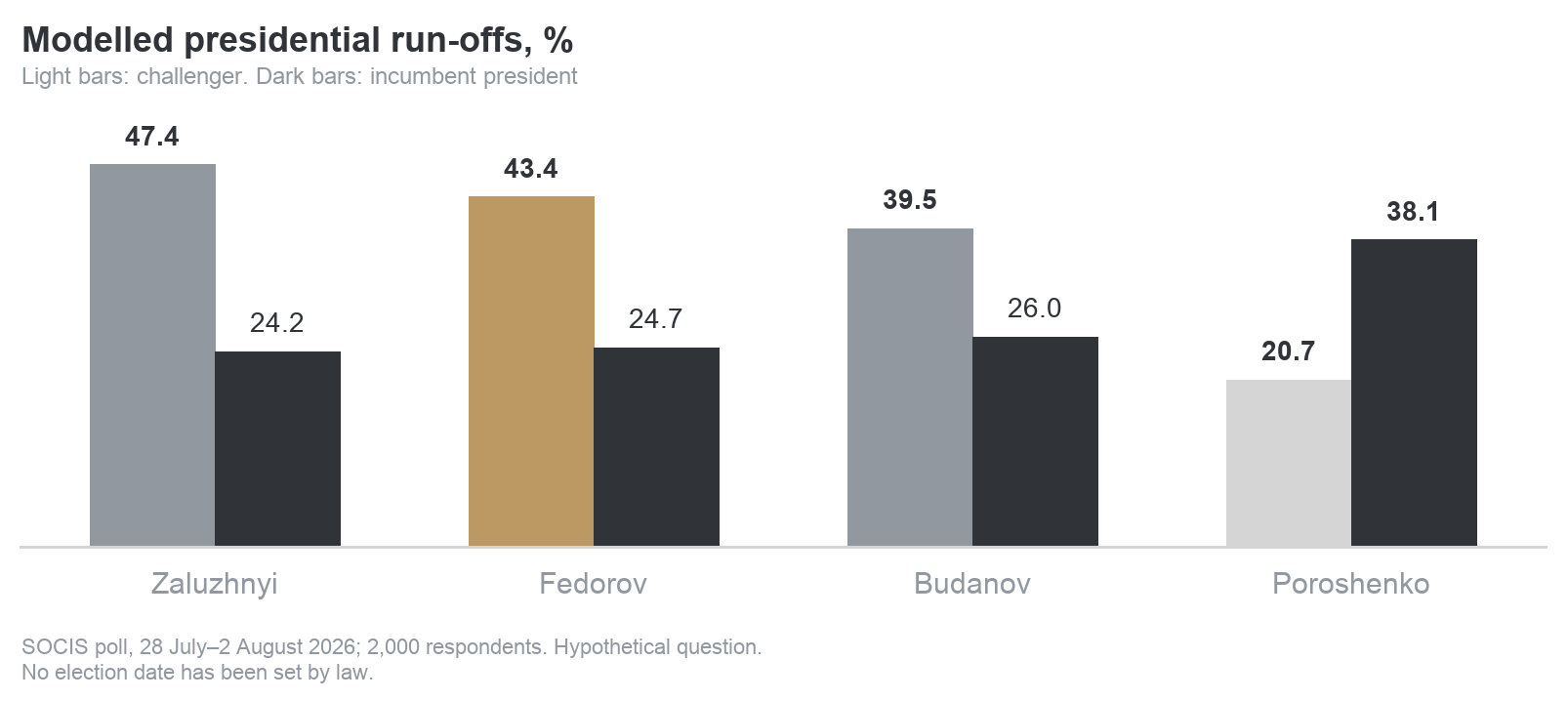
Petro Poroshenko represents the traditional opposition and never belonged to the incumbent president's team. He was the only one of the four potential challengers whom Zelenskyy did not lose to in this comparison. The principal threat to the president therefore comes not from his old opponents, but from figures made nationally prominent by his own administration.
Public office alone does not guarantee support. Their reputations were shaped by performance, the conditions of wartime and public attitudes. Zelenskyy helped make them nationally known but could not control their subsequent popularity.
How a strong official becomes a presidential rival
Appointing a weak leader risks failure for which the president himself must answer. A strong leader delivers results, but visibility also gives that official an independent base of public support.
Once removed, such a figure is no longer bound by the same political loyalty.
A president would normally keep a popular subordinate within the team through party discipline, participation in elections and a place on the governing party's list. With elections suspended, those instruments do not operate. Dismissal remains available, but it releases the politician from prior obligations without erasing popularity.
Where Fedorov's supporters came from
According to SOCIS, Zelenskyy's decline in support coincided with a rise in Fedorov's rating.
Respondents were also asked whom they would support if their preferred candidate did not stand. These are known as second preferences. Fedorov's supporters most often chose Zaluzhnyi, followed by Budanov. Only a small share was prepared to return to Zelenskyy.
For the authorities, this means that Fedorov's disappearance from politics would probably not return his supporters to the president. They would divide among Zelenskyy's other rivals. The poll does not, however, show that everyone who left the president moved directly to Fedorov. One rating falling while another rises is not proof of a transfer of votes.
Why distrust matters
The Kyiv International Institute of Sociology (KIIS), a Ukrainian public-opinion research organisation, reported the following results:
- 66% trusted Zaluzhnyi and 24% distrusted him; - 63% trusted Fedorov and 16% distrusted him; - 61% trusted Budanov and 22% distrusted him; - 56% trusted Zelenskyy and 38% distrusted him.
The difference in their net trust ratings is only four points. That is not enough to state confidently that Fedorov leads Zaluzhnyi on this measure.
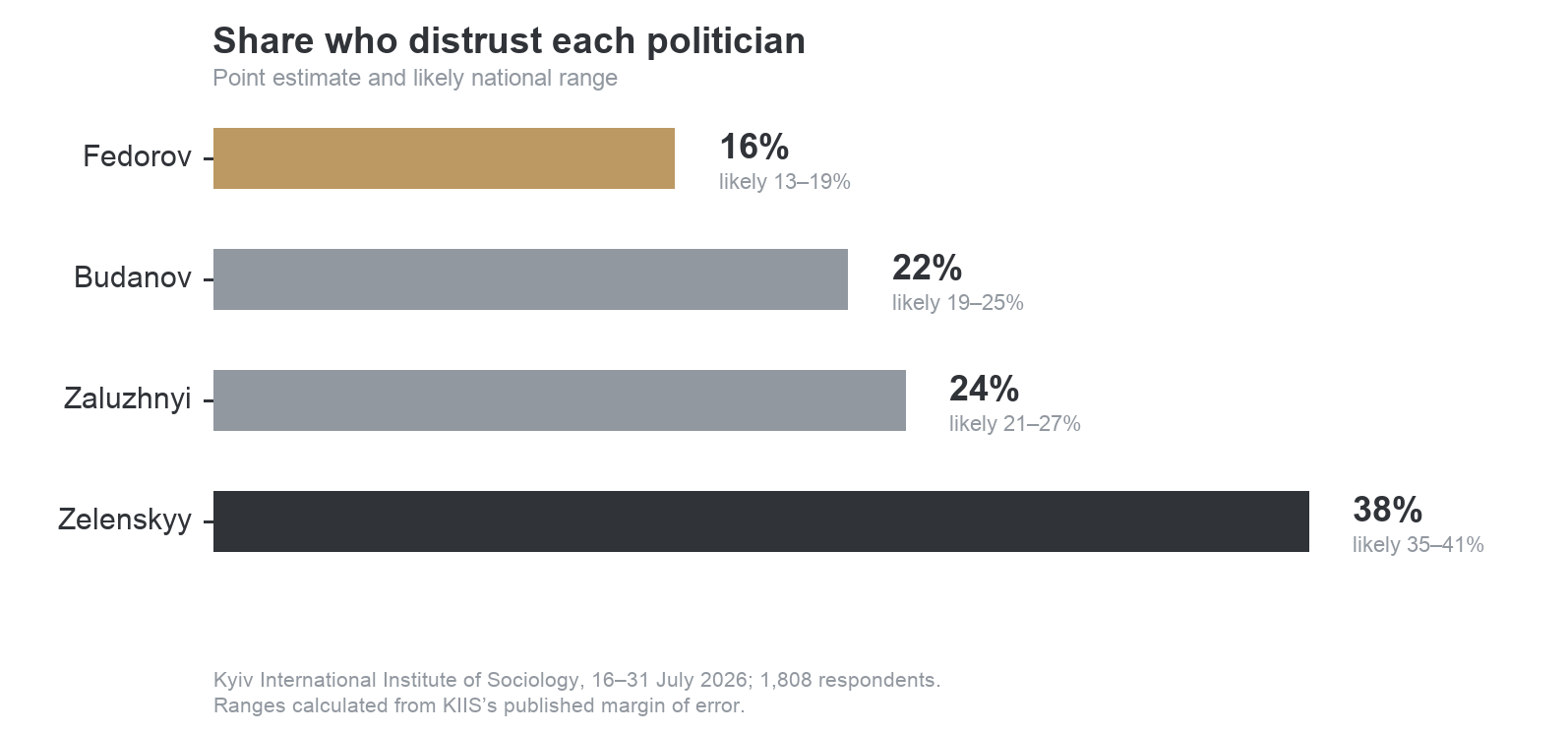
The share who distrust each politician is worth comparing separately. Sixteen per cent distrusted Fedorov, against 24% for Zaluzhnyi, an observed gap of eight percentage points. The published results do not provide enough information to calculate the statistical significance of this specific comparison independently.
This measure matters because rebuilding the trust of someone already opposed to a politician is usually harder than persuading an undecided voter. Fedorov's low distrust leaves him with a large potential constituency. For a politician who has neither a party nor a campaign organisation, that is his principal advantage.
Gap
How to read the polls. According to KIIS's own figures, Fedorov's net trust rating is plus 46 points, compared with plus 42 for Zaluzhnyi. The institute publishes this measure directly, alongside the trust and distrust figures for each politician. Polls conducted during wartime do not cover Ukraine's entire population. Answers to hypothetical run-off questions capture opinion at the time of the survey; they do not predict the result of a future election. Fedorov's low distrust rating may also reflect the fact that he has not yet fought a real political campaign or faced sustained scrutiny as an independent candidate. The durability of his support can be tested only once open political competition begins.
Part Four · What a politician can retain after leaving office
A dismissed politician may retain public support, a team, foreign relationships and access to funding. Those assets determine whether the former official can become an independent rival to the government.
If the office takes the team, relationships and money with it, political influence gradually disappears. If those resources survive, dismissal does not eliminate a rival; it merely releases that rival from previous obligations to the authorities.
As of the cut-off date, public support was the only asset Fedorov had certainly retained. Reports that part of his team might follow him remained unconfirmed. His foreign relationships were built while he held public office, and it is unclear whether they continued to operate after his dismissal. He had no independent political organisation or verified source of funding.
What Fedorov retained — across four assets:
- Public support — confirmed by polls conducted after his resignation (the surveys ran from 16 to 31 July, after Fedorov had left office). Confidence: high. - Team — some staff may follow Fedorov out; this was reported by one anonymous source, and no names or personnel decisions have been published. Confidence: low. - Foreign relationships — existed while he was in government; there is no confirmation that these relationships survived his resignation or now belong to Fedorov personally. Confidence: low. - Independent organisation — no party, movement or political structure; no public evidence of one was identified. Confidence: high. - Funding — not established; no open-source evidence of independent funding or political infrastructure. Confidence: low.
What sustains Fedorov's reputation
High public trust after his dismissal shows that Fedorov's popularity was not tied solely to office. It does not mean, however, that every claim about his record has been documented.
The most prominent example concerns UAH 300 billion. Fedorov's supporters said that an audit conducted under his leadership had identified ineffective defence spending on that scale.
The Main Communications Directorate of the Armed Forces of Ukraine, which issues the military's official explanations, said that no large-scale audits of combat brigades had taken place in 2026. The military command had also received no information about such audit findings.
The statements may have referred to different reviews. Fedorov may have been discussing expenditure within the Ministry of Defence, while the military's response concerned inspections of combat units. The published evidence does not resolve the discrepancy.
Until the audit report, the expenditure reviewed and the calculation method are published, UAH 300 billion cannot be treated as a verified finding. The figure is therefore not used in this report's principal conclusions.
Assessment
What this means for his reputation. Fedorov's reputation as a successful reformer rests in part on his claim that UAH 300 billion had been spent inefficiently. The documents supporting that figure have not been published. His current popularity therefore does not yet show whether his reputation will survive scrutiny of specific results. Fedorov also has verifiable achievements. An electronic defence-procurement system began operating during his tenure, allowing military units to order the equipment they required directly. According to Ukraine's Ministry of Defence, by May 2026 the system had delivered about 485,000 pieces of equipment, with an average of roughly nine days from order to receipt. These figures were published by the ministry itself. This report found no independent confirmation, but the military command did not publicly dispute them.
Did the team leave with Fedorov?
One report, citing an unnamed member of Fedorov's team, said that some Ministry of Defence staff might leave with him. It named neither the employees nor any decisions they had taken. Khmara, by contrast, said that he wanted to retain key members of the previous team, including specialists responsible for procurement reform and international support. A collective departure therefore cannot yet be treated as established.
The next formal personnel decisions will answer the question. If several deputies and programme heads leave the ministry and continue working with Fedorov, he will have the beginnings of an independent team. If they remain, their common bond was likely their work at the ministry rather than personal loyalty to its former head.
Part Five · Possible paths over the next year
Four possible paths for the coming year are set out below. We do not assign numerical probabilities because the open evidence cannot support precise calculation. Percentages would create an illusion of precision.
Developments on the battlefield or in negotiations could, however, transform the political situation much faster than events inside the country.
Fedorov's support gradually dissipates
Fedorov does not establish an independent political force. His former colleagues remain at the Ministry of Defence and he appears in public less often. Some supporters move to Zaluzhnyi, Budanov or other politicians.
Without a team of his own, sustained activity or a clear political objective, Fedorov's popularity gradually declines. His rivals either remain more popular or continue to hold public office and command a public platform.
Early indicators: prominent officials do not leave the ministry to join Fedorov, no independent political structure emerges, and autumn polls show his support falling.
Fedorov builds his own team
Fedorov establishes a political movement or permanent organisation. He begins speaking regularly not only on defence but across the national agenda. A programme, public representatives and identifiable sources of funding emerge.
Three conditions would have to hold: public demand for a new political figure remains strong; experienced administrators are prepared to leave public office and join Fedorov; and those people decide that working with him is more attractive than returning to the existing governing system.
Early indicators: several senior figures leave the Ministry of Defence, a legal organisation is registered, its representatives begin speaking under a common banner and a political programme is published.
A return to government
Zelenskyy offers Fedorov a position with substantive authority and Fedorov accepts. For the president, this would bring a potential rival back under control. For Fedorov, it would restore office, a team and access to state resources.
Both men would have to explain a sharp reversal. Fedorov has already rejected three proposed positions. Zelenskyy, meanwhile, secured the appointment of Yevhen Khmara as defence minister with support from more than two-thirds of MPs.
Early indicators: Zelenskyy and Fedorov hold a confirmed meeting, stop criticising one another publicly, and the president then offers Fedorov a specific post.
Elections are scheduled
Parliament passes an election law and a voting date is announced. Fedorov's current rating then becomes less important than his ability to build a campaign organisation, find allies, secure funding and run a nationwide campaign.
Protests and polls would remain relevant but would no longer stand in for absent elections. This report's central question — how power changes without a vote — would lose much of its relevance.
Early indicators: an election bill is introduced, a timetable is published, and procedures are defined for service personnel, displaced citizens and Ukrainians abroad.
Events that could render these paths irrelevant
A sharp change in the war or negotiations could transform domestic politics completely. In that case, these paths would cease to matter and the analysis would have to be rebuilt around the new circumstances.
What to watch — by indicator:
- Staff follow Fedorov out — as of 20 August, not confirmed. Would change the assessment: several deputies or department heads leave the Ministry of Defence and continue working with Fedorov — this would show that he is building a team of his own. - Creation of a political force — as of 20 August, no party, movement or permanent team. Would change the assessment: Fedorov registers an organisation, appoints representatives and begins sustained public activity. - Public attitudes towards Fedorov — as of 20 August, distrusted by 16% of respondents. Would change the assessment: distrust rises markedly after he enters open politics — this would indicate that current support reflected an absence of serious criticism. - Preparations for elections — as of 20 August, no proposal, bill or voting date. Would change the assessment: an election bill is introduced in parliament and a preparation timetable is announced — the report's central conclusion would then need to be reconsidered. - Contact between Fedorov and Zelenskyy — as of 20 August, no confirmed meetings since the conflict. Would change the assessment: a public meeting and an offer of a specific post would make Fedorov's return to government more likely.
Part Six · What would show that we were wrong
An analytical judgement is testable only if the facts that would overturn it are specified in advance. The developments below would show that individual conclusions in this report were wrong or expressed with excessive confidence.
Combined pressure fails to produce a result. We assess that the authorities retreat more readily when society, state institutions and foreign partners apply pressure together rather than separately. If all three factors repeatedly coincide and the authorities do not retreat, this judgement will need to be revised. One case would not be sufficient because other circumstances may determine the decision.
A single factor proves sufficient. If the authorities begin regularly conceding to protests alone or to anti-corruption investigations alone, there will be no reason to combine them with external pressure in one model. Each mechanism will have shown that it can operate independently.
Fedorov's support falls sharply. If trust in Fedorov collapses after he enters open political competition and the share who distrust him rises far above the current 16%, his present popularity will have proved temporary. A modest decline would be a normal consequence of sustained public criticism and would not by itself overturn the assessment. The test is a sharp fall in support.
The team remains at the Ministry of Defence. If deputies and programme heads keep their posts, Fedorov will have no independent team outside the ministry. He will have retained public support after dismissal, but not acquired an organisation of his own.
Elections are scheduled. If parliament passes an election law and a voting date appears, the report's central conclusion will need to be reconsidered. Protests and investigations will continue to influence the authorities, but they will no longer partly substitute for an absent lawful transfer of power.
What we could not verify
- We could not find a detailed account of former commander-in-chief Oleksandr Syrskyi's position on the causes of his conflict with Fedorov. The military command's perspective is therefore incomplete. - The report that part of Fedorov's team might leave rested on one unnamed source. The employees and their decisions were not identified. - NABU and SAPO did not publish documents establishing the formal status of every person affected by the 19 August operation. A search cannot therefore be treated automatically as a charge or proof of guilt. - The audit report behind the UAH 300 billion figure is not publicly available. Neither the calculation nor the expenditure reviewed can be checked. - The polls pre-dated Fedorov's 18 August address. They do not show how that intervention affected public attitudes. - Some state decisions could not be checked against primary documents. In those cases, we relied on publications summarising their contents. Each instance is identified in the notes.
Fact
How the report was checked. In preparing this report, we compared several analytical papers produced independently of one another. This exposed discrepancies in dates, facts and explanations of the same events. An external reviewer then read the text, and the present edition incorporates that review. The report was not, however, reviewed by a panel of specialists in Ukrainian domestic politics. Independent comparison and external review reduce the risk of error, but do not replace a full expert assessment.
Part Seven · The constrained autonomy of the Ukrainian state
Ukraine's president, parliament and government retain the authority to take state decisions. Their freedom of choice is nevertheless constrained by the country's dependence on Western funding, arms supplies, diplomatic backing and the prospect of European Union membership.
Foreign partners do not need to issue direct orders. They can make continuing assistance conditional on the adoption of particular laws, the preservation of specific institutions or compliance with political conditions. The formal decision is taken in Kyiv, but refusal may mean less funding, delayed deliveries or deteriorating relations with allies.
Foreign states and organisations therefore participate in Ukraine's domestic politics in practice. They can make some choices available and others prohibitively costly for the Ukrainian authorities.
Why there is no single West
The United States, the United Kingdom and the European Union do not always pursue the same objectives. Their agencies, political groups and associated organisations may support different people and advocate different outcomes.
The change of administration in Washington widened these differences. Relationships built by Ukrainian politicians under Joe Biden do not necessarily carry the same weight under Donald Trump. A new US administration may rely on different intermediaries, officials, entrepreneurs and politicians.
Conflicts within Ukraine's governing system may therefore reflect not Kyiv's resistance to external control, but competition among several foreign centres for influence over a dependent political system. Formal authority remains with Ukrainian institutions, but the boundaries of what is possible are shaped to a considerable degree abroad.
What this means for Fedorov
While in government, Fedorov built relationships with US technology companies, Western donors and organisations supporting Ukraine's digital and defence projects.
Those relationships may give him independent access to parts of the American political and business establishment. Such a channel would not necessarily run through the officials and organisations on which Zelenskyy's circle relied under the Biden administration.
Fedorov can therefore be viewed as a potential participant in a different external network of influence. There is not yet sufficient evidence, however, to conclude that the Trump administration directly supports him or that he acts as its political representative.
When external pressure works
External pressure is most effective when it aligns with demands inside Ukraine. That is what happened in the confrontation over the anti-corruption institutions. Protesters and representatives of the European Union opposed the restrictions, and parliament rapidly repealed the law under their combined pressure.
A demand from abroad may not be enough on its own. When it coincides with domestic discontent, however, refusal becomes far more costly for the authorities.
Why defence appointments matter
Personnel decisions at the Ministry of Defence affect more than military administration. They also shape foreign partners' confidence in how the Ukrainian authorities use the money and weapons provided to them.
The dispute over procurement and the alleged audit findings showed how quickly unverified figures become weapons in a political struggle. Until the primary documents are published, neither Ukrainian society nor Ukraine's foreign partners can independently test the competing claims.
Why every new crisis is more dangerous
The longer elections remain suspended, the more public dissatisfaction accumulates. Yet there is still no lawful mechanism for replacing the country's leadership.
For a state dependent on external backing, this creates an additional vulnerability. Every serious domestic conflict attracts the attention of foreign partners, who gain an opportunity to support one side, impose conditions or link assistance to their preferred outcome.
Hypothesis
What to track instead of rumours. Claims of foreign backing for Ukrainian politicians are often made without adequate evidence. Such claims should be tested against concrete indicators, not anonymous assertions:
- public, confirmed meetings
- sources of funding
- the identity of advisers and intermediaries
- endorsements by Western officials
- participation by associated organisations in a politician's projects
- conditions attached to financial and military assistance
- personnel decisions taken after external signals
- subsequent votes in the Verkhovna Rada
Fedorov has documented links to the US technology sector and Western organisations. Evidence of direct political backing from a specific foreign centre nevertheless remains insufficient. Funding, permanent intermediaries and public endorsements would distinguish the former minister's working international relationships from the emergence of an independent foreign base of support.
Conclusion · What the past year in Ukraine has shown
Ukraine's governing system continues to function. Parliament confirms governments and passes laws. Zelenskyy appoints ministers and changes the military command. State institutions implement the decisions taken.
Yet the system's freedom of action is becoming increasingly constrained. The decisions of the president and parliament are simultaneously shaped by street protests, anti-corruption bodies and the foreign partners on whose support the country depends.
Within thirteen months, parliament repealed a law curtailing the independence of the anti-corruption bodies. Over the same period, the head of the Office of the President, the commander-in-chief of the Armed Forces and a deputy head of the presidential office all lost their positions. In each case, the combination of domestic and external pressure raised the cost of preserving the previous decision.
These forms of influence do not replace elections. Protests and investigations can force the authorities to repeal a law or dismiss an official. They cannot allow society to choose a new leader and confer a lawful right to govern. While voting remains suspended, society can force the reconsideration of individual decisions but cannot form a new government.
Fedorov's case reveals another limit. He retained strong public support after leaving office. In the late-July polling cited above, only 16% of respondents distrusted him, the lowest figure among the politicians examined, even though the fieldwork took place after he had left government.
Popularity alone, however, is not enough to make an independent political figure. Fedorov has no confirmed team outside the state apparatus, no political force of his own and no known source of funding. He retained a reputation after dismissal but has yet to prove that he can turn it into political power.
The authorities concede not to one source of pressure but when several overlap. This is an operating mechanism, not coincidence. Where only one factor was present, it did not produce the same result.
Zelenskyy's principal rivals are people whom he himself appointed to senior state positions. The main threat comes not from the old opposition, but from within: figures whom Zelenskyy turned into national personalities. Their offices made Zaluzhnyi, Budanov and Fedorov known across the country, while their performance gave them independent public support. Petro Poroshenko, the representative of the traditional opposition, was the only one of four potential challengers whom Zelenskyy did not lose to in the poll.
Protests, investigations and external pressure can repeal a law or remove an official, but they cannot choose a successor. Discontent therefore accumulates without an outlet. This weakens the authorities and deepens their dependence on foreign support, in part because the country lacks a legitimate means of replacing its leadership.
What Fedorov's political future will reveal
The first question is whether his deputies and programme heads at the Ministry of Defence will leave with him.
If several officials leave and continue working with Fedorov, he will have the basis of an independent team. If they stay, their bond was the work of the ministry rather than personal loyalty to its former head. Fedorov would then remain a popular politician without an organisation of his own.
The second question is whether distrust remains low once Fedorov enters open political competition. Sixteen per cent currently distrust him. Sustained criticism could change public attitudes once he begins fighting for power.
Both questions may be answered within months. Formal personnel decisions, Fedorov's own conduct and new polling will provide the test.
This report is based on open sources. Its analytical cut-off is 21 August 2026. Part Six identifies the new facts that would require its principal conclusions to be reconsidered.
Appendix · How disputed dates and events were checked
In preparing this report, we compared several independently produced studies. They differed on dates, omitted important events and described the same decisions in different ways.
The discrepancies we identified, the version used in this report and the reasons for that choice are set out below.
- Date of Fedorov's election appeal. Conflict in the materials: some give 18 August; others, 19 August. Version used: 18 August, 21:57. Basis for the choice: time-stamped reports appeared on the evening of 18 August. This matters because the appeal preceded the vote on the new minister. - Government's resignation. Conflict in the materials: some omit that the entire Cabinet resigned. Version used: on 14 July, Ukraine's parliament dismissed the entire government. Basis for the choice: this follows from the Verkhovna Rada's decision. Fedorov was not dismissed by a separate act, so it would be wrong to treat the resignation as directed personally against him. - Fedorov's removal from Ukraine's National Security and Defence Council. Conflict in the materials: the event is omitted from some materials. Version used: 31 July. Basis for the choice: the date appears in Presidential Decree No. 677/2026 amending the composition of the National Security and Defence Council. - Dismissal of Commander-in-Chief Oleksandr Syrskyi. Conflict in the materials: reported as either 21 or 22 July. Version used: announced on 21 July; formal documents followed on 21 and 22 July. Basis for the choice: we distinguish Zelenskyy's public announcement from the subsequent legal formalisation of the decision. - Fedorov's statement that he did not want to enter politics. Conflict in the materials: omitted from almost all the materials. Version used: 31 July. Basis for the choice: The New York Times published an interview with Fedorov that day. The original was not accessible to us, so its contents were checked against several reports summarising the interview.
What remains a hypothesis
Open evidence confirms the Ukrainian authorities' general dependence on foreign support. The involvement of particular states or organisations in individual personnel decisions could not be established in every case.
- One publication alleged that a particular foreign centre was involved in Fedorov's dismissal. Other sources did not corroborate the claim, and the article itself provided no testable evidence. - Another account suggested that a foreign state was preparing its own candidate for a future election. The author offered political interpretation but identified no person, funding source or action demonstrating such support. - Fedorov's address and the new anti-corruption operation occurred almost simultaneously. Open sources do not show that the two events were coordinated in advance or that Fedorov influenced the investigation. - There were reports that some members of the former minister's team were prepared to leave with him. Until specific employees are identified and formal personnel decisions are published, such a transfer cannot be treated as having occurred.
How events could show we were wrong
An analytical judgement is testable only if the facts that would overturn it are specified in advance.
- Combined pressure fails to produce a result. We assess that the authorities retreat more readily when society, state institutions and foreign partners apply pressure together rather than separately. If all three factors repeatedly coincide and the authorities do not retreat, this judgement will need to be revised.
- A single factor proves sufficient. If the authorities begin regularly conceding to protests alone or to anti-corruption investigations alone, there will be no reason to combine them with external pressure in one model.
- Fedorov's support falls sharply. If trust in Fedorov collapses after he enters open political competition and the share who distrust him rises far above the current 16%, his present popularity will have proved temporary. A modest decline would be a normal consequence of sustained public criticism and would not by itself overturn the assessment — the test is a sharp fall in support.
- The team remains at the Ministry of Defence. If deputies and programme heads keep their posts, Fedorov will have no independent team outside the ministry.
- Elections are scheduled. If parliament passes an election law and a voting date appears, the report's central conclusion will need to be reconsidered — protests and investigations will continue to influence the authorities, but they will no longer partly substitute for an absent lawful transfer of power.
Source registry
Revision history
ZARYA. "The Street Vote: Who can force Ukraine's government to reverse its decisions while elections remain suspended — and how?." August 21, 2026. https://zaryaintel.com/en/cases/ulichnyy-votum
No companion piece assigned to this line yet. Back to the library →